How to Manage Personal Finances Offline: Tips for Tracking Expenses Without Internet


Table of Contents
In today’s hyper-connected digital landscape, it feels almost impossible to manage our lives without an active internet connection. From social media to grocery shopping, the cloud dictates our daily rhythms. This is especially true for personal finance. App stores are flooded with budgeting tools that require you to link your bank accounts, sync your data to remote servers, and maintain a constant Wi-Fi or cellular connection. But what happens when you are traveling in a dead zone? Or more importantly, what if you simply do not want your sensitive financial data sitting on a third-party server waiting for the next inevitable data breach?
Welcome to the “offline-first” approach to personal finance. Managing your money without the internet is not a step backward into the stone age rather, it is a deliberate, mindful, and highly secure way to take control of your financial destiny. Whether you are prioritizing data privacy, seeking to build better spending habits through manual entry, or just needing a reliable system that works regardless of your connectivity, offline expense tracking is a powerful methodology.
In this comprehensive guide, we will explore the tangible benefits of disconnecting your finances and provide you with actionable methods to track your expenses completely offline.
Why Go Offline? The Strategic Advantages of Disconnected Finance
Before diving into the “how,” it is crucial to understand the “why.” Choosing to manage your finances offline offers several profound benefits that cloud-based automated apps simply cannot match.
Unparalleled Privacy and Security: When you use a connected budgeting app, you are essentially handing over a comprehensive map of your life. These apps know where you shop, how much you earn, your medical expenses, and your travel habits. By keeping your financial ledgers offline, you eliminate the risk of your data being mined for targeted advertising, sold to third-party brokers, or exposed in a corporate data hack. Your data remains strictly on your device or in your physical notebook.
Increased Financial Mindfulness: Automated financial tools are incredibly convenient perhaps too convenient. When an app automatically categorizes your $5 morning coffee or a $100 late-night online shopping spree, it is easy to ignore the gradual accumulation of these expenses. Offline tracking forces you to manually record every single transaction. This slight friction creates a psychological speed bump, forcing you to acknowledge your spending behavior in real time. Over time, this mindfulness naturally curbs impulse buying and fosters intentional spending.
Ultimate Reliability and Independence: If you travel frequently, you know that reliable internet is not a global guarantee. An offline system works flawlessly in an airplane cabin, a remote mountain lodge, or a foreign country where you lack a local data plan. Furthermore, offline tracking protects you from “vendor lock-in” and subscription fatigue. You will never lose access to your financial history just because a software company decides to shut down its servers or hike its monthly fees.
The Classic Analog Approach: Pen, Paper, and the Kakeibo Method
For those who want to completely sever the digital tether, the traditional pen-and-paper method remains an unbeatable champion of simplicity and focus. Writing down numbers engages the brain differently than typing, reinforcing your financial reality through tactile feedback.
To start an analog ledger, you do not need an expensive, pre-formatted planner. A standard notebook will suffice. One of the most effective analog frameworks to adopt is Kakeibo, the traditional Japanese art of budgeting. Invented in 1904 by Hani Motoko, Japan’s first female journalist, Kakeibo revolves around four simple questions:
- How much money do you have available?
- How much would you like to save?
- How much are you actually spending?
- How can you improve?
Setting Up Your Ledger:
At the beginning of each month, dedicate a page to your fixed income and fixed expenses (such as rent, utilities, and insurance). Subtract your fixed expenses and your monthly savings goal from your total income to find your “spending allowance.”
Next, create a daily logging section divided into four distinct categories:
Survival: Absolute necessities like groceries, transport, and medical care.
Optional: Things you enjoy but do not necessarily need, such as dining out or shopping.
Culture: Books, movies, museum visits, and educational materials.
Extra: Unforeseen expenses like car repairs or a spontaneous birthday gift.
At the end of the week, sit down for a ten-minute review. Tally up the columns and compare them against your spending allowance. This analog ritual is incredibly grounding and requires absolutely zero battery life.
Mastering the Offline Spreadsheet
If you prefer the mathematical power and organization of the digital world but still want to remain entirely offline, a locally saved spreadsheet is your best friend. Desktop programs like Microsoft Excel, Apple Numbers, or the free, open-source LibreOffice Calc offer robust platforms for building a highly customized financial dashboard.
The true beauty of a spreadsheet lies in its flexibility. You are the architect of your financial house, meaning you can track exactly what matters to you without navigating a cluttered app interface.
Structuring Your Offline Tracker:
Begin by creating a new, locally saved file. Set up a “Master Log” sheet with the following essential columns: Date, Amount, Category, Vendor/Description, and Payment Method (e.g., Cash, Credit Card, Debit).
To harness the power of the spreadsheet and prevent typing errors, utilize data validation. Create a separate sheet listing your specific spending categories (e.g., Housing, Groceries, Entertainment, Utilities). Apply a drop-down list to the “Category” column in your Master Log based on this list. This ensures your data entry is uniform, which is vital for accurate reporting later.
Automating the Math (Without the Cloud):
You do not need an internet connection to use powerful formulas. By using the `SUMIFS` function, you can automatically pull data from your Master Log into a Monthly Summary sheet. For example, you can tell the software to “sum all the amounts in the Master Log where the category is ‘Groceries’ and the month is ‘October’.”
Add a few bar charts or pie graphs linked to your summary table, and you instantly have a visual representation of your financial health. Keep this file stored strictly on your local hard drive, and back it up weekly to an external encrypted USB drive for ultimate data security.
Leveraging Offline-First Financial Applications
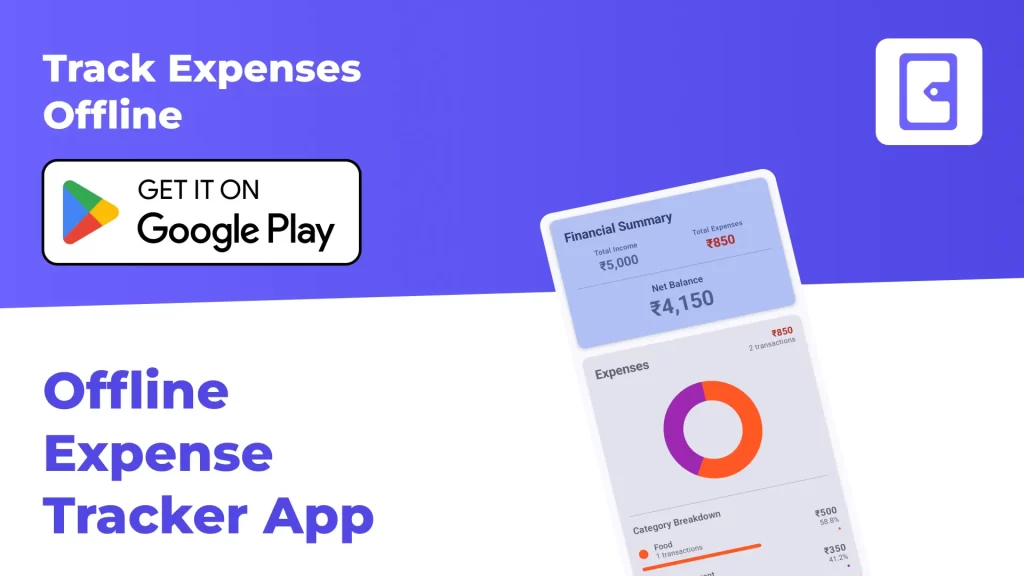
Going offline does not necessarily mean you have to abandon modern user interfaces or the convenience of your smartphone. A growing movement in software development is the “offline-first” architecture. These are applications designed to function completely natively on your device, storing data locally in a self-contained database rather than pushing it continuously to a remote cloud server.
What to Look For:
When searching for an offline-first personal finance app, look for the following defining features:
No Mandatory Account Creation: You should not need to provide an email address, verify your identity, or create a password on a remote server just to open the app.
Local Storage: The app must explicitly state that your data lives exclusively on your device.
Manual Entry Focus: Because it cannot connect to your bank, the user interface should be optimized for incredibly fast manual data entry.
Robust Export Options: True ownership of your data means you can leave the app whenever you want. The software must allow you to export your data to a standard CSV file.
Using an offline-first app on your smartphone offers a fantastic hybrid advantage. You gain the immediate convenience of pulling your phone out of your pocket at the grocery store to log a $50 expense in three seconds, but you retain the security and privacy of an entirely disconnected ecosystem.
Building and Sustaining an Offline Routine
The single biggest challenge of managing personal finances offline is the loss of automated tracking. Because a bank server is not doing the work for you in the background, your success depends entirely on building a sustainable habit. Without a routine, your notebook will gather dust, and your spreadsheet will remain blank.
The Receipt Method: Whenever you make a purchase, ask for a physical receipt, or take a screenshot of a digital receipt on your phone. Dedicate a specific physical tray on your desk or a folder on your computer for these receipts. This acts as your financial “inbox.”
The Weekly Reconciliation: Choose one day a week Sunday evenings are usually ideal to process your inbox. Brew a cup of coffee or tea, play some relaxing music, and spend fifteen minutes transferring the data from your receipts into your physical ledger, spreadsheet, or offline app. Once logged, safely shred or delete the receipts.
Daily Micro-Logging: Alternatively, if a weekly task feels overwhelming, make logging expenses the final part of your daily evening routine. Take two minutes before bed to quickly jot down whatever you spent that day. This daily touchpoint keeps your financial status top-of-mind and prevents an intimidating backlog of unrecorded transactions.
Conclusion
Taking your personal finances offline is a rebellious and empowering act in an era defined by constant connectivity and corporate data harvesting. By relying on a physical ledger, a localized spreadsheet, or an offline-first application, you reclaim ownership of your highly sensitive information and foster a deeper, more mindful relationship with your money.
Remember, personal finance is precisely that personal. There is no universally perfect system, only the system that works consistently for you. Whether you find clarity in the tactile scratch of a pen on paper or the organized grid of an Excel file, tracking your expenses without the internet offers unparalleled privacy, absolute reliability, and a clear, focused path to your financial goals. Disconnect your data, build your routine, and take control of your wealth on your own terms today.