Expense Lite Essentials: A Student’s Roadmap to Budget Success


Table of Contents
- The Unique Financial Ecosystem of a Student
- Why Complex Systems Fail (And Why Expense Lite Excels)
- Your 4-Step Roadmap to Budgeting Success
- Step 1: Log Instantly Using the "5-Second Rule"
- Step 2: Categorize for Clarity, Not Confusion
- Step 3: Implement the Student-Modified 50/30/20 Rule
- Step 4: Conduct the "Sunday Financial Review"
- Navigating Common Pitfalls with Data
- Securing Your Financial Future Today
Navigating student life is a thrilling, transformative experience, but it often comes with a glaring, unavoidable challenge: managing money. For most students, the transition to college or university is the first real taste of financial independence. Suddenly, you are the chief financial officer of your own life. You are responsible for stretching a limited pool of resources whether from a part-time job, student loans, scholarships, or parental support across an ever-growing list of expenses. From overpriced textbooks and late-night study snacks to rent, transportation, and the occasional social outing, the demands on your wallet are relentless.
When you are living on a tight budget, every single rupee, dollar, or euro matters. Yet, traditional personal finance advice often feels disconnected from the student reality. You don’t need complex investment portfolios or convoluted spreadsheet formulas right now you need clear, actionable visibility into your daily spending. You need a system that fits seamlessly into a life heavily scheduled with lectures, assignments, and exams.
This is where adopting a minimalist approach to budgeting becomes your greatest asset. By leveraging streamlined tools like Expense Lite, you can remove the friction from personal finance. Here is your comprehensive roadmap to mastering your money, eliminating financial anxiety, and building wealth-management habits that will last a lifetime.
The Unique Financial Ecosystem of a Student
To understand how to fix student budgeting, we first have to understand why it breaks down. The student financial ecosystem is highly irregular. Unlike a salaried professional who receives a predictable paycheck every two weeks, a student’s cash flow is often erratic. You might receive a large lump sum at the beginning of the semester from a grant or loan, which creates a false sense of wealth. Fast forward two months, and you are surviving on instant noodles because that initial sum evaporated faster than anticipated.
Furthermore, students are uniquely vulnerable to “invisible” expenses. The five-dollar coffee between classes, the multiple streaming subscriptions required to unwind, the split cab fares, and the peer pressure to eat out all drain your accounts in micro-transactions. Individually, these purchases feel insignificant. Cumulatively, they are budget-destroyers.
When financial stress hits, it takes a severe psychological toll, directly impacting academic performance and mental health. The cognitive load of worrying about rent or groceries leaves less brainpower for studying. Therefore, finding a budgeting method is not just about being “good with money” it is a critical strategy for academic and personal survival.
Why Complex Systems Fail (And Why Expense Lite Excels)
The biggest mistake students make when trying to get their finances in order is overcomplicating the process. Driven by a burst of motivation, you might download a heavy, feature-bloated accounting app or build a sprawling, color-coded spreadsheet. For the first three days, it feels empowering. But by day four, when you are rushing to a morning lecture and buy a quick pastry, logging that small expense into a complex system feels like a chore. You tell yourself you’ll log it later. You don’t. The data becomes inaccurate, the budget breaks, and you abandon the system entirely.
Budgeting fails when the friction of tracking an expense outweighs the perceived benefit.
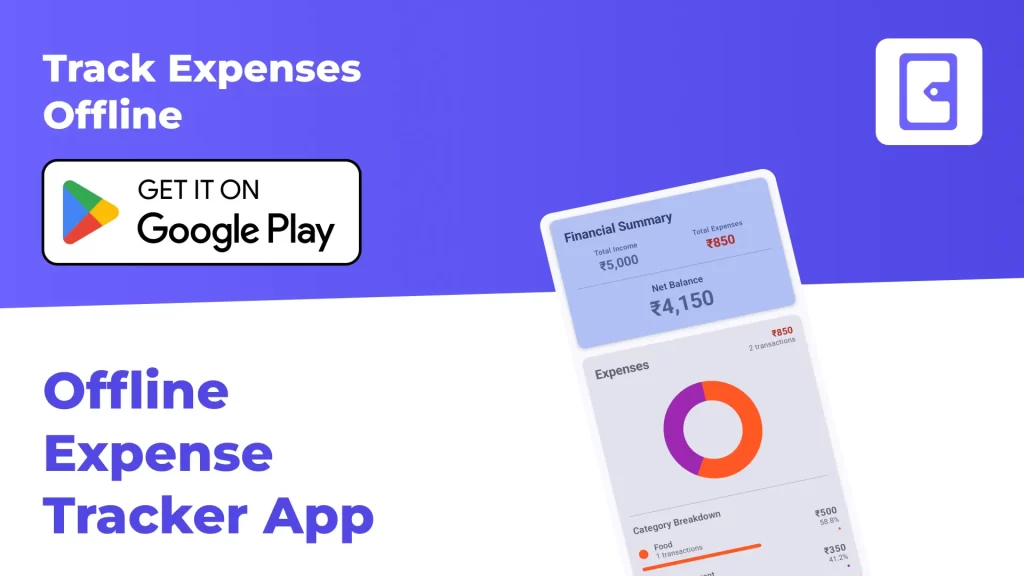
Expense Lite solves this core problem through intentional minimalism. Designed to be lightweight and blazing fast, it removes the barriers between making a purchase and recording it. There are no overwhelming charts to decipher upon opening the app, no mandatory integration with a dozen bank accounts that constantly unsync, and no labyrinth of menus to navigate. It is a focused, purpose-built tool that does exactly what a student needs: it tracks where your money is going instantly. By prioritizing a clean user interface and rapid data entry, Expense Lite ensures that tracking your spending becomes a reflex rather than a project.
Your 4-Step Roadmap to Budgeting Success
With the right tool in your pocket, building a sustainable budget becomes a matter of applying a few foundational habits. Here is how you can use Expense Lite to map out your financial success.
Step 1: Log Instantly Using the “5-Second Rule”
The golden rule of student budgeting is real-time tracking. Do not rely on your memory at the end of the week, and do not wait for your monthly bank statement. Your memory will omit the small things, and your bank statement arrives too late to change your behavior.
Commit to the 5-Second Rule: the moment you hand over your card or cash, open Expense Lite and log the transaction. Because the app is streamlined, this takes less than five seconds. By logging expenses at the point of purchase, you force yourself to acknowledge the money leaving your possession. This simple act of mindfulness is often enough to curb impulsive spending.
Step 2: Categorize for Clarity, Not Confusion
When setting up your Expense Lite categories, resist the urge to create fifty different micro-categories. If your categories are too specific (e.g., “Tuesday Morning Coffees,” “Blue Pens”), tracking becomes tedious. If they are too broad (e.g., “Stuff”), the data is useless.
Aim for 5 to 8 core categories that reflect a student’s life. A highly effective setup includes:
Housing & Utilities: Rent, electricity, internet.
Groceries: Supermarket runs and essential food items.
Academics: Textbooks, software licenses, printing, and stationery.
Transportation: Bus passes, gas, or ride-shares.
Dining & Social: Restaurants, coffees, movies, and events.
Health & Personal: Pharmacy needs, hygiene products, gym memberships.
By grouping your spending into these clear buckets within Expense Lite, you will be able to see exactly which area of your life is draining your funds with a single glance.
Step 3: Implement the Student-Modified 50/30/20 Rule
You have likely heard of the 50/30/20 budgeting rule: 50% for needs, 30% for wants, and 20% for savings. While this is a fantastic framework for established professionals, it can be mathematically impossible for a student whose rent alone might consume 60% of their income.
Instead, use Expense Lite to establish a Modified Student Ratio. Calculate your absolute baseline the non-negotiable costs of staying enrolled and housed. Let’s say this takes up 70% of your income. That leaves you with 30%. Dedicate 20% to your “Wants” (socializing, hobbies) and relentlessly protect the remaining 10% for an emergency fund. As a student, your emergency fund is your armor against disaster. A broken laptop or a sudden medical bill can derail a semester. Use Expense Lite to track your 10% savings contributions just as rigorously as you track your expenses.
Step 4: Conduct the “Sunday Financial Review”
Data is only valuable if you analyze it. Set a recurring 15-minute appointment with yourself every Sunday evening to review your Expense Lite dashboard.
Look at the visual summaries of your week. Did you spend way more on dining out than you intended? Are your academic expenses higher than expected this month? This review is not meant to be a guilt trip it is an educational feedback loop. If you overspent on social events this week, you don’t need to panic. You simply use that data to make an informed decision to cook at home for the next few days. Expense Lite gives you the agility to course-correct in real-time, long before your bank account hits zero.
Navigating Common Pitfalls with Data
As you progress on your budgeting journey, you will inevitably encounter financial traps. One of the most common is “Subscription Fatigue.” It is incredibly easy to sign up for free trials of study apps, streaming services, and premium software, only to forget about them when the auto-renew kicks in. By consistently logging every recurring charge into Expense Lite, you create a glaring, unavoidable list of your subscriptions. When things get tight, this list is the first place you look to trim the fat.
Another major pitfall is peer pressure. It is incredibly difficult to say “no” when your friends want to go to an expensive restaurant. However, when you have a clear, visual representation of your budget in Expense Lite, it changes the psychological dynamic. You are no longer saying “no” because you are vaguely broke you are saying “no” because you have consciously allocated those funds to your textbook budget or your emergency savings. Having clear data empowers you to set boundaries without feeling deprived.
Securing Your Financial Future Today
Managing money on a tight student budget is undeniably challenging, but it is also one of the most valuable educational experiences you will ever have. The financial constraints you face today are the perfect training ground for the wealth you will manage tomorrow.
By utilizing a frictionless, minimalist tool like Expense Lite, you strip away the intimidation and complexity of personal finance. You learn to track your invisible spends, categorize your life logically, set realistic boundaries, and pivot when necessary. Budgeting is not about restricting your freedom it is about ensuring that your limited resources are actively working to support your goals, your education, and your peace of mind. Start small, log consistently, and watch as those simple daily habits pave a smooth, secure roadmap to lifelong financial success.