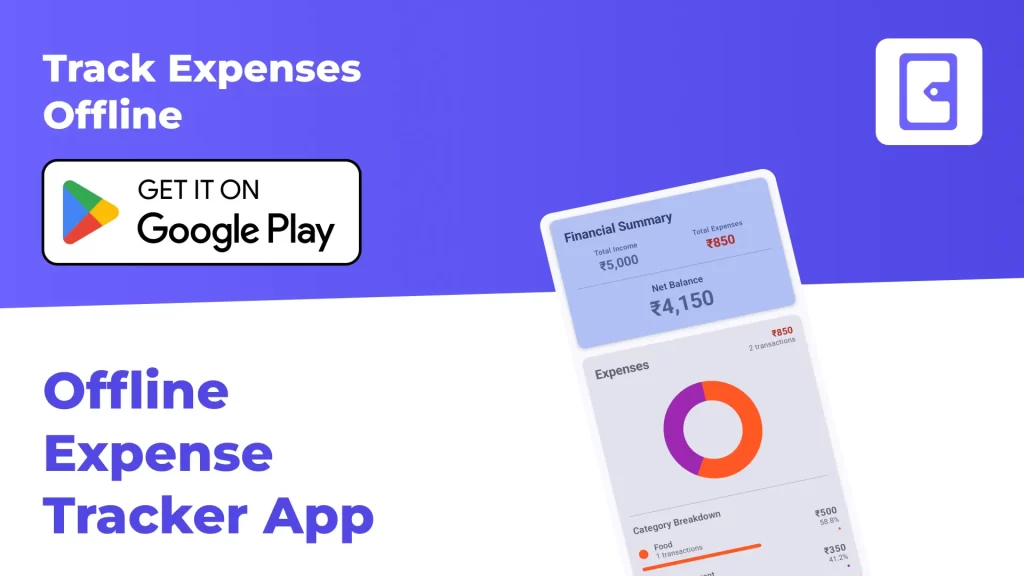
Offline Expense Tracking: Protect Your Data and Stay Organized Without Wi‑Fi


Table of Contents
We live in a hyper-connected era where almost every application on our smartphones relies on an umbilical cord to the internet. We expect our devices to continuously ping servers, fetch updates, and sync data in real time. But what happens when you step into a concrete building, board an airplane, or travel to a remote area with spotty cellular service? For many apps, the screen goes blank, a loading wheel spins infinitely, and you are locked out of your own information.
When it comes to personal finance and tracking your daily expenses, this reliance on constant connectivity is not just an inconvenience it is a significant barrier to building good financial habits. Managing your money requires consistency, speed, and absolute privacy. This is where the “offline-first” philosophy comes in. By utilizing offline expense tracking, you can protect your most sensitive data, eliminate the frustration of loading screens, and stay perfectly organized without ever needing a Wi-Fi connection.
Understanding the “Offline-First” Architecture
To fully appreciate the value of an offline expense tracker, it helps to understand what “offline-first” actually means. It is not merely a feature it is a fundamental architectural paradigm in software development.
Historically, most modern financial apps have been built as “cloud-first.” In a cloud-first application, the primary source of truth is a remote server. When you enter an expense say, a $4 coffee the app sends that data through the internet to a server. The server processes it, saves it to a database, and sends a confirmation back to your phone. If your connection drops during this process, the transaction fails.
An offline-first application reverses this hierarchy. The primary source of truth is a local database housed entirely on your device’s internal storage. When you log that same $4 coffee, the app saves it immediately to the local database. The transaction is complete instantly. If the app offers optional cloud synchronization, it will quietly push that data to the server in the background only when a stable connection is established.
There is a distinct difference between being “offline-capable” and “offline-first.” An offline-capable app might let you view cached data without the internet, but it restricts you from adding new entries. An offline-first app, however, offers 100% of its core functionality whether you are on a high-speed fiber network or completely off the grid.
The Unbeatable Advantages of Disconnecting Your Finances
Choosing to track your expenses locally rather than relying on cloud-dependent services offers a multitude of benefits that directly impact your privacy, your time, and your financial hygiene.
1. Uncompromising Data Privacy and Sovereignty
Financial data is arguably the most sensitive information you generate. It reveals where you live, where you shop, what you eat, and what you value. When you use a free, cloud-first expense tracker, your data is often stored on third-party servers. In many cases, these companies monetize your data by analyzing your spending habits to serve targeted advertisements or by selling aggregated data to marketing firms.
With an offline-first tracker, you achieve true data sovereignty. Your financial records live strictly on your silicon. Unless you explicitly choose to export or sync your data, it never leaves your phone. This completely eliminates the risk of your personal spending habits being caught up in a corporate data breach or being analyzed by algorithms. You own your data, plain and simple.
2. Lightning-Fast Performance and Zero Friction
Friction is the enemy of any good habit. If it takes you fifteen seconds to open an app, wait for it to authenticate with a server, and load your dashboard, you are highly likely to say, “I’ll just log this receipt later.” More often than not, “later” never comes, and your budget falls out of balance.
Because offline trackers read and write data to your phone’s local storage, the response time is measured in milliseconds. There are no loading spinners and no waiting for API calls to resolve. The app opens instantly, allowing you to log an expense in the few seconds it takes a cashier to hand you your change. This frictionless experience is critical for maintaining an accurate, up-to-date budget.
3. Total Reliability for Travelers and Commuters
If you travel frequently, you already know the pain of restrictive data roaming charges and the unreliability of public Wi-Fi. Yet, traveling is precisely when you need an expense tracker the most, as you are constantly spending money on transportation, meals, and accommodations. An offline expense tracker allows you to meticulously log your vacation spending while riding the subway, flying at 30,000 feet, or hiking in a remote national park. You never have to worry about your app freezing up just because you lost your 5G signal.
Establishing a Seamless Offline Tracking Routine
Having the right tool is only half the battle the other half is utilizing it to build a resilient financial routine. The sheer speed of an offline-first app makes it incredibly easy to integrate expense tracking into your daily life without it feeling like a chore.
The most effective strategy is “point-of-sale logging.” Because you don’t need to wait for a network connection, make it a rule to log your purchase before you put your wallet back in your pocket. Whether you are buying groceries, paying for a taxi, or grabbing a quick snack, input the amount and categorize it immediately.
Furthermore, you can use your offline tracker to perform regular financial reviews anywhere. If you are commuting underground on a train without cellular service, you can use that dead time to review your weekly spending charts, adjust your budget categories, and plan for upcoming bills. You are transforming internet dead zones into productive moments for your financial health.
Keeping Your Data Safe: Backups and Exports
One valid concern people have when transitioning to offline-first tools is the risk of data loss. If all your financial data lives exclusively on your smartphone, what happens if you drop your phone in a lake or it gets stolen? Does your entire financial history disappear with it?
This is where understanding data management becomes essential. A robust offline-first app provides tools to mitigate this risk without forcing you to compromise your privacy.
Manual and Automated Local Backups
Most high-quality offline trackers allow you to generate backup files. These backups can be saved directly to your phone’s local storage or moved to a physical hard drive via a USB cable. Establishing a routine of backing up your data once a week ensures that, at most, you would only ever lose a few days’ worth of entries in the event of hardware failure.
Standardized Data Exports
Another hallmark of a good offline tool is the ability to export your data in universal formats, such as CSV (Comma Separated Values) or JSON. Exporting a CSV file allows you to open your expense history in desktop spreadsheet software like Microsoft Excel, Google Sheets, or Apple Numbers. This not only acts as a backup but also empowers you to run complex, custom financial analyses on a larger screen.
Opt-In, Encrypted Cloud Sync
If you still want the convenience of cloud backups without the privacy trade-offs of a cloud-first app, look for offline-first trackers that offer end-to-end encrypted synchronization. In this model, the app encrypts your database on your device before sending it to a personal cloud drive (like Google Drive or iCloud). Because the encryption key remains on your device, the cloud provider cannot read your financial data they only see scrambled code. This gives you the best of both worlds: the speed and privacy of local storage, combined with the disaster recovery benefits of the cloud.
Taking Control of Your Financial Future
In a digital landscape that increasingly demands constant connectivity and relies on harvesting user data, choosing an offline expense tracker is a deliberate step toward digital minimalism and privacy. It forces the technology to work for you, on your terms, rather than tethering your financial organization to the reliability of a cell tower.
By adopting an offline-first approach, you strip away the friction of loading screens and network errors. You guarantee that your financial data remains yours alone. Most importantly, you equip yourself with a tool that is as fast, reliable, and available as you need it to be, empowering you to stay perfectly organized and in total control of your money no Wi‑Fi required.